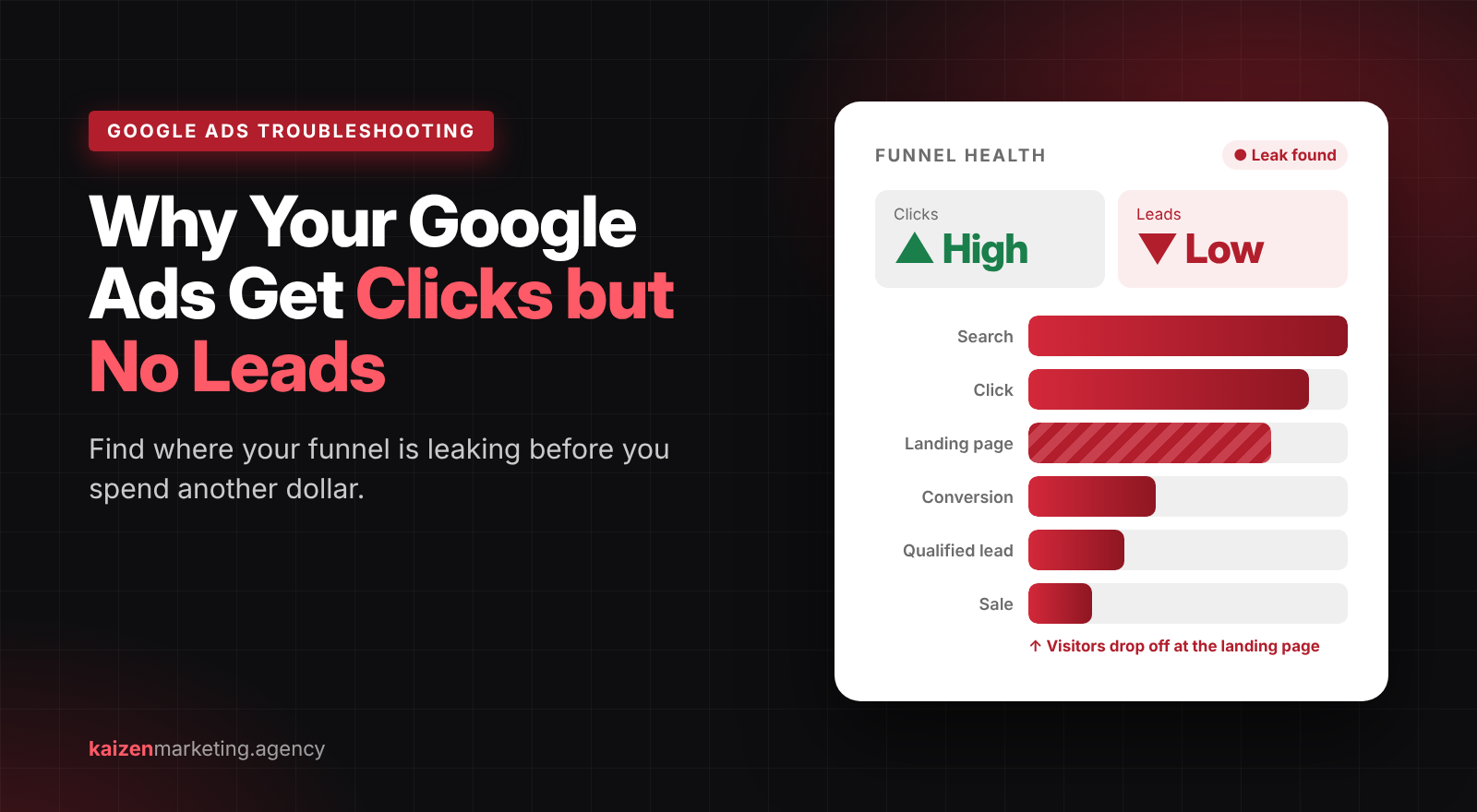
You open Google Ads, and the numbers don't look terrible. People are clicking. Traffic is reaching your website. Your budget is being spent. But your phone isn't ringing, your lead generation efforts aren't being submitted, and your sales team isn't getting enough opportunities. If that sounds familiar, the problem usually isn't simply that Google Ads doesn't work for your business. More often, there is a breakdown somewhere between:
Search → click → landing page → conversion → qualified lead → sale
Finding that breakdown is the difference between continually increasing your advertising budget and actually improving your return. At Kaizen, we've managed more than $10 million in advertising spend, and one of the most common problems we see when reviewing campaigns is businesses tracking results beyond clicks without examining what happens after the click.
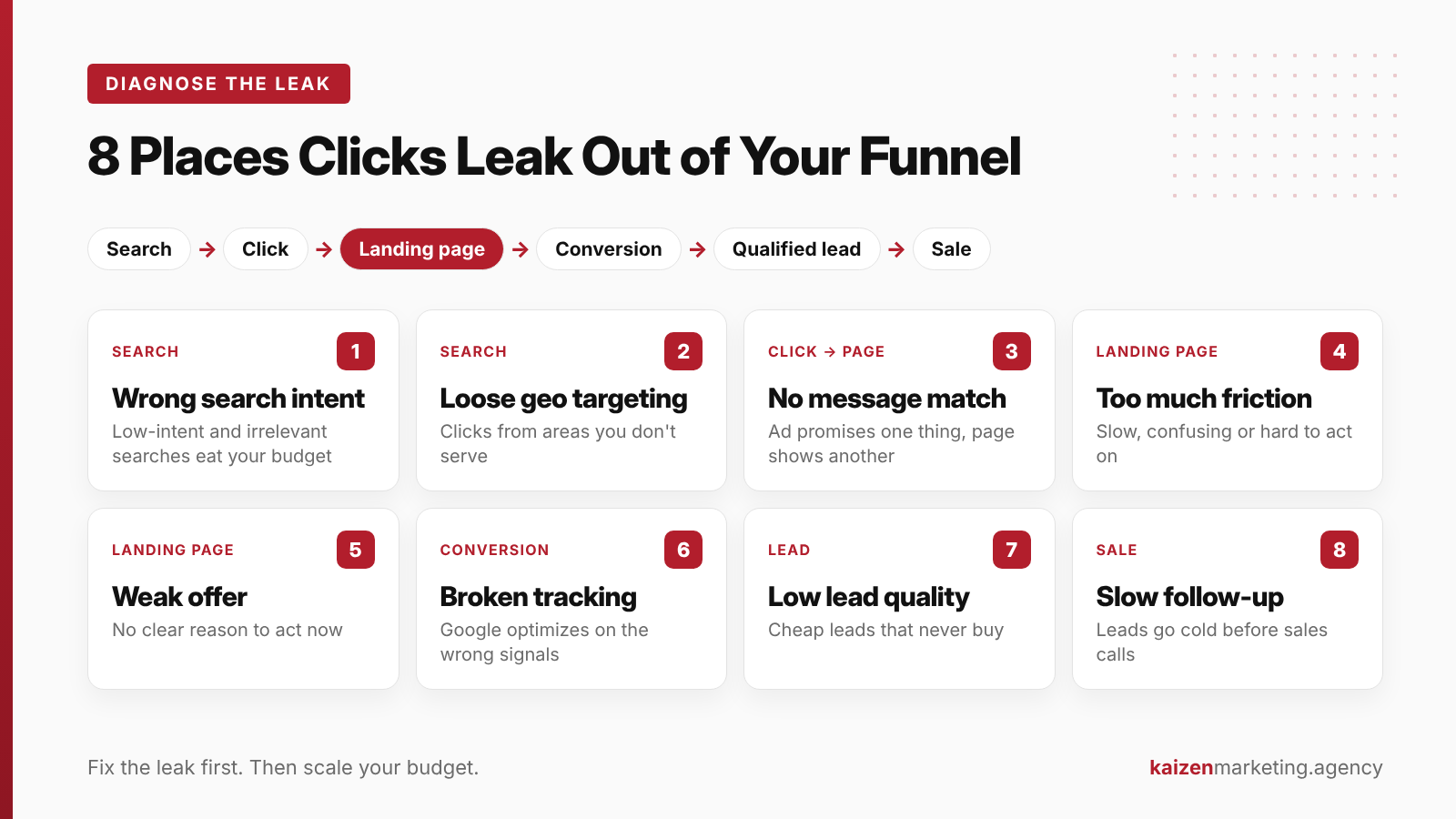
Here are the first areas we would investigate.
Getting traffic isn't the same as getting buyer traffic. Imagine you're a roofing company bidding on:
roof repair
That sounds relevant.
But Google may also match your ads with searches like:
Those people may click your ad, but they're unlikely to request an estimate.
This is why one of the first things we examine is the Search Terms report, not just the keywords listed inside the campaign.
Look at what people actually typed before clicking your ads.
Ask:
Negative keywords, tighter keyword targeting, and better campaign segmentation can often reduce wasted traffic before you change anything else.
Don't optimize for clicks. Optimize for intent.
A campaign generating 500 clicks from low-intent searches may produce fewer customers than one generating 100 highly qualified clicks.
Traffic volume isn't the goal.
Profitable customers are.
Suppose someone searches:
emergency AC repair
They click your ad and land on a generic homepage that talks about:
HVAC installation, maintenance plans, heating systems, company history, commercial service options, residential services, and several other offerings.
The visitor now has to figure out where to go.
That's unnecessary friction.
The closer the landing page matches the original intent, the easier the conversion becomes.
Someone searching for emergency AC repair should ideally land on a page primarily about emergency AC repair.
Someone searching for Google Ads management shouldn't land on a generic marketing-agency homepage.
This concept is usually called message match.
Your keyword → ad → landing page → call to action should feel like one continuous conversation.
Not sure your ads and landing pages are aligned? Get a FREE Growth Game Plan from Kaizen →
Sometimes the advertising is fine.
The website is the problem.
A visitor clicks your ad and encounters:
Every additional question a visitor has to answer themselves creates another opportunity to leave.
Your landing page should quickly answer:
For lead-generation campaigns, that could be:
Not:
Learn more.
Advertising can put the right person in front of your business.
It cannot force them to want your offer.
Consider two advertisers selling essentially the same service.
The second gives the visitor a much clearer reason to act.
An offer doesn't necessarily mean discounting.
It can be:
The important question is:
Why should someone convert now instead of continuing to compare competitors?
If the answer isn't clear, Google Ads may successfully generate traffic while the offer fails to generate action.
This is one of the most expensive problems because it can cause you to optimize campaigns using inaccurate campaign data.
Google Ads might report:
20 conversions
But what actually happened?
Maybe:
Or the opposite problem occurs.
The business receives phone calls and form submissions, but they aren't being tracked properly inside Google Ads.
Now Google's bidding system doesn't know which traffic is actually valuable.
At minimum, businesses running serious lead-generation campaigns should understand what happens across:
Click → lead → qualified lead → customer → revenue
This is also why Kaizen places so much emphasis on attribution.
A campaign shouldn't be judged only by clicks or even raw lead volume.
Ultimately, you need to know whether your advertising is contributing to revenue and profit.
Not sure your conversion tracking is accurate? Let Kaizen review your Google Ads for free →
Suppose Campaign A produces:
50 leads at $40 each
Campaign B produces:
20 leads at $70 each
At first glance, Campaign A wins.
But now look at the sales data.
Suddenly the more expensive lead source is considerably more valuable.
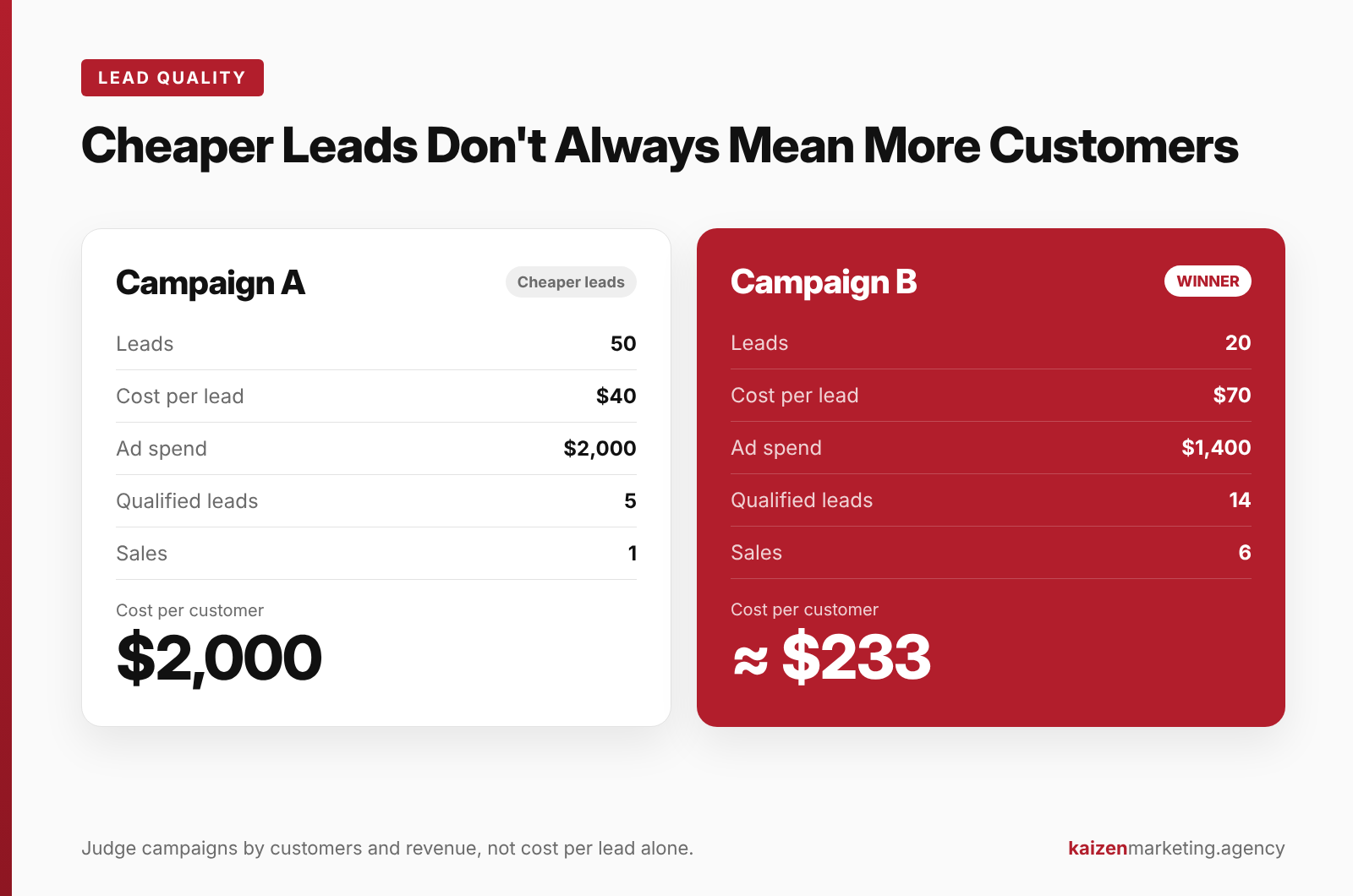
This is why cost per lead can become misleading when it is viewed without lead quality.
A $30 lead that never buys is expensive.
A $150 lead that becomes a $15,000 customer may be extremely profitable.
The goal shouldn't always be:
How do we get cheaper leads?
The better question is:
How do we acquire more profitable customers?
Local businesses should examine where their clicks are actually coming from.
A Houston business may believe it's advertising exclusively to Houston customers while receiving traffic from areas it doesn't serve.
The same issue can occur with:
and surrounding markets.
Review campaign location settings as well as actual user-location reports.
For service-area businesses in particular, irrelevant geographic clicks can quietly consume a meaningful portion of the budget.
This is the part advertising reports often don't show.
Google Ads generates the lead.
Then:
The advertising platform sees a conversion.
The owner sees no revenue.
Both can technically be correct.
That's why evaluating advertising performance requires looking beyond the ad account.
Ask:
Marketing and sales performance cannot always be separated.
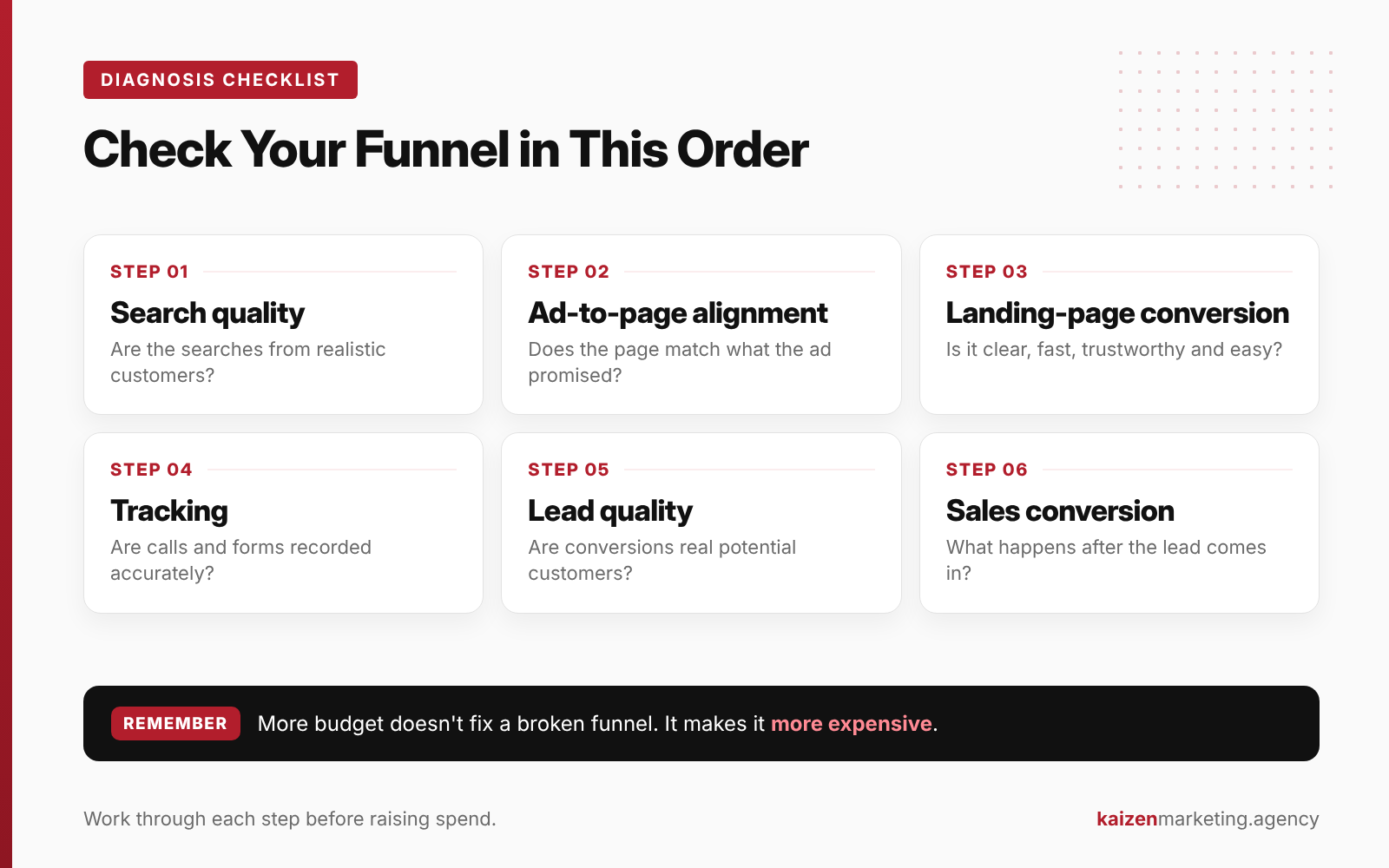
If your Google Ads are getting clicks but not generating leads, we would investigate the funnel in this order:
This approach matters because simply increasing the budget doesn't fix a broken funnel.
It usually makes the broken funnel more expensive.
There isn't one universal number.
A campaign with 20 clicks and no conversions may simply not have enough data.
A campaign with 1,000 highly relevant clicks and no qualified leads clearly has a larger problem.
The answer depends on factors such as:
Rather than using an arbitrary click threshold, evaluate whether the amount you've spent is reasonable for customer acquisition relative to the value of acquiring a customer.
If acquiring one customer is worth $10,000 to your company, the acceptable testing budget is very different from a business where an average transaction generates $50.
When a campaign isn't generating enough leads, the instinct is often:
Increase the budget.
But if the underlying funnel is broken, you're simply buying more of the same problem.
Before spending more, determine:
That's how advertising becomes a revenue system rather than a traffic-generation system.
Before you raise your budget, find the leak. Book your free 15-min Growth Game Plan call →
Clicks are useful.
Impressions are useful.
Conversions are better.
But they are still intermediate metrics.
The final question is:
That's the philosophy behind how Kaizen approaches paid advertising. We've managed more than $10 million in advertising spend, and our focus isn't simply getting businesses more traffic. It's building measurable customer-acquisition systems where owners can understand what's happening to their money.
Kaizen Marketing can review your advertising, tracking, landing-page experience and lead flow to identify where potential customers are dropping out. Contact us today!
Get your free Growth Game Plan →
Q: Why am I getting Google Ads clicks but no conversions?
A: Common causes include poor keyword intent, overly broad targeting, weak landing pages, unattractive offers, conversion-tracking problems and irrelevant traffic.
Q: Can Google Ads generate leads for small businesses?
A: Yes, but success depends heavily on search demand, targeting, economics, landing-page conversion and the business's ability to convert leads into customers.
Q: Should I stop my Google Ads if they aren't generating leads?
A: Not necessarily. First determine whether the issue is targeting, tracking, landing-page performance, lead quality or insufficient data. Stopping campaigns without diagnosing the problem can eliminate useful data without solving the underlying issue.
Q: How can I improve the quality of Google Ads leads?
A: Focus on high-intent searches, use negative keywords, improve message match, and track qualified leads instead of raw conversions.
Q: How many clicks should I get before worrying about results?
A: There is no universal number. Consider conversion rate, service price, industry, search intent, location, sales cycle, and historical performance.
Let's talk about your business and how are services and values can help you finally achieve your business goals. No fancy marketing, just a transparent conversation.